
Momentum Builds in Albany as the New York State Good Guardianship Act Advances
By admin
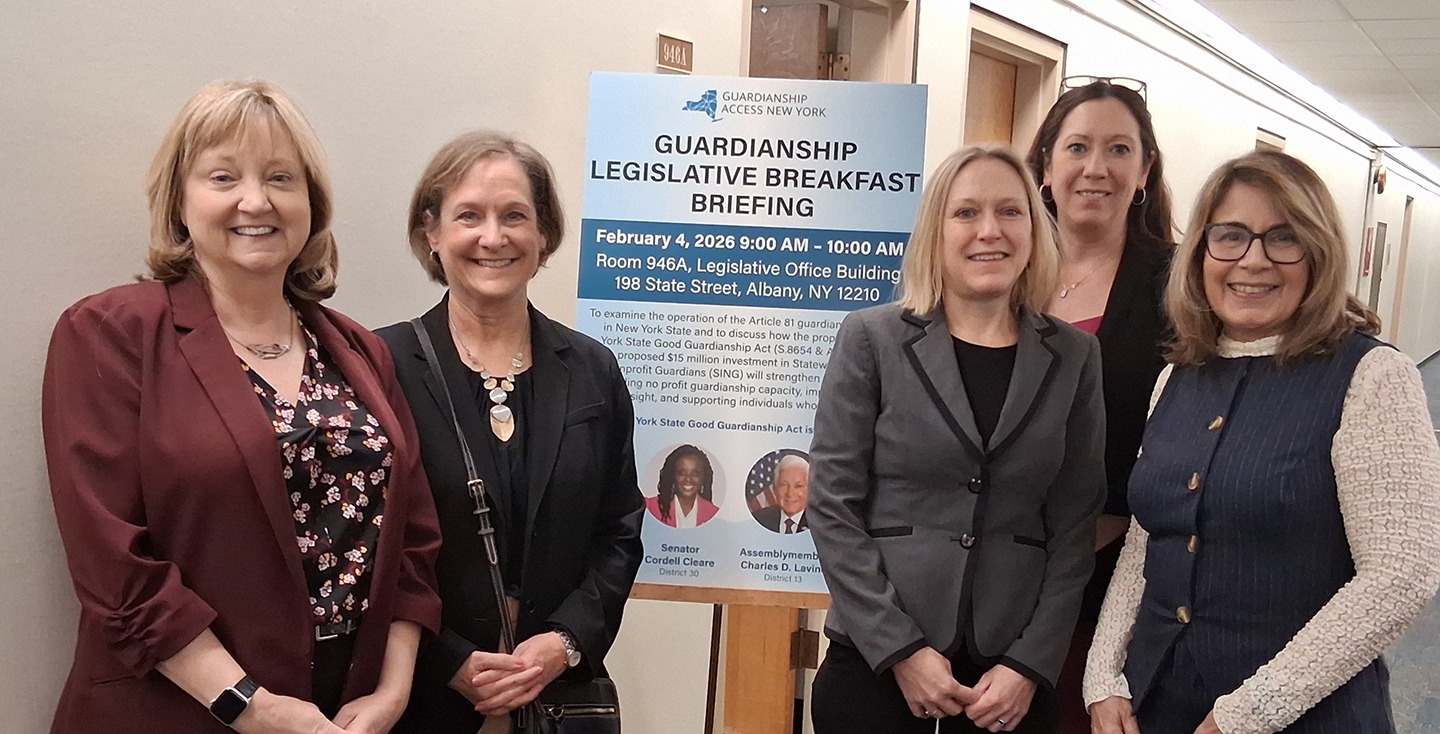
A Legislative Office Building meeting room was standing room only as lawmakers, advocates, and nonprofit leaders from Guardianship Access New York coalition (GANY) convened for a briefing on guardianship reform, reflecting growing momentum to address a system that serves some of New York’s most vulnerable residents yet remains chronically underfunded.
The briefing came at a pivotal time. Just moments before it began, ProPublica published the latest installment in journalist Jake Pearson’s ongoing series on the “unbefriended” — older adults and people with disabilities who need a guardian but have no family or friends to serve on their behalf. Over the last two years, Pearson’s reporting has documented the severe resource shortages and structural gaps facing New York’s Article 81 guardianship system, which continues to operate with insufficient public funding. In the most recent article, nonprofit guardianship services were described as stretched “very, very thin,” a reality echoed throughout the Albany discussions.
That sustained reporting has helped elevate public and legislative awareness of a long-standing problem: guardianship in New York is relied upon as a critical safety net, yet it is funded as if it were optional. Now, for the first time, legislation has been introduced to address that imbalance by making a $15 million annual investment in nonprofit guardianship services statewide, providing stability, consistency, and capacity where none currently exists.
Assembly Member Charles Lavine (D–Long Island), chair of the Assembly Judiciary Committee, introduced the New York State Good Guardianship Act and has expressed confidence that it will pass this session, noting that the bill faces no opposition and directly responds to a clearly identified gap in the state’s care infrastructure.
In the chamber, Senator Cordell Cleare (D–Harlem), chair of the Senate Aging Committee, is championing the bill. On Wednesday, it passed the Senate aging committee.
After the roundtable, Kimberly George, President and CEO of Project Guardianship, testified before New York State Legislature about the need for dedicated funding for nonprofit guardianship in New York and the importance of the New York Good Guardianship Act.
The momentum felt in Albany this week reflects a broader groundswell of activity around Article 81 and issues impacting older adults across New York. Last year, New York City Council passed Resolution 0561, calling on the State Legislature to introduce and pass — and the Governor to sign — legislation creating a statewide public guardianship system. The resolution explicitly cited inequities and funding deficits that leave many New Yorkers without access to timely, appropriate guardianship when it is needed most.
However, while support for reform is evident among city and state lawmakers, Governor Kathy Hochul made no mention of guardianship in her preliminary budget for Fiscal Year 2027, which was released last month. As Kimberly George, President and CEO of Project Guardianship and a leading advocate with the Guardianship Access New York coalition (GANY), stated in the recent ProPublica article, “What’s it going to take for the governor to pay attention to guardianship and realize that there’s a viable solution on the table?”
For advocates, the message from Albany was clear: the issue is not a lack of awareness or effort on the ground; it is a lack of investment. With legislative momentum growing and solutions plainly articulated, the New York State Good Guardianship Act represents a critical opportunity to finally fund a system New York has long depended on but never adequately supported.